

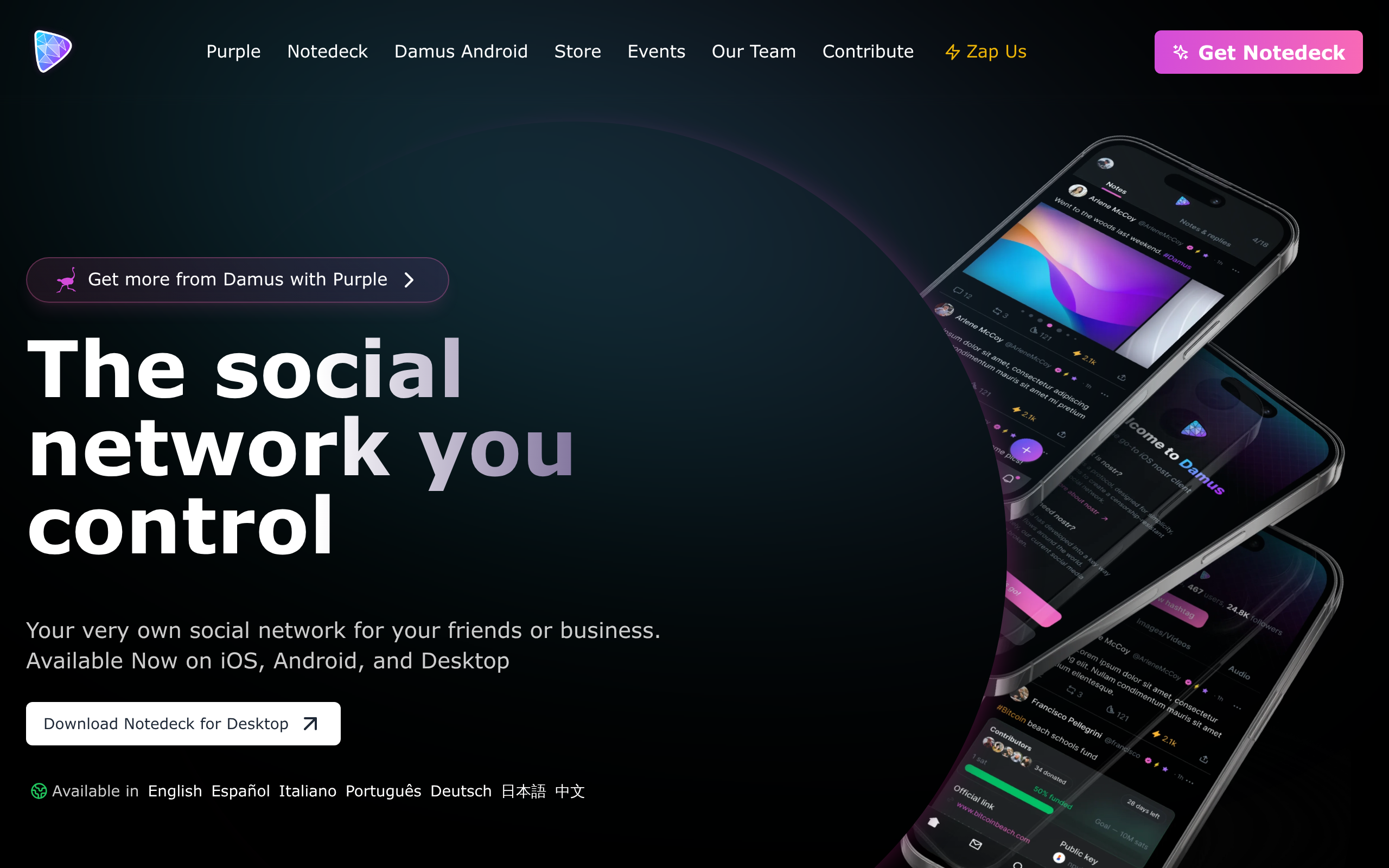
Description
Damus is a decentralized social networking client built on the Nostr protocol. It reimagines social media by putting users in control — no central platform can ban accounts, censor posts, or sell user data.
Key Features
- Decentralized & Censorship-Resistant — Built on open Nostr relays, there is no single entity that can ban or censor you.
- No Registration Required — Create an account without a phone number, email, or real name. Your identity is secured by cryptographic keys.
- No Addictive Algorithms — Content is ordered chronologically, not by engagement-maximizing algorithms designed to keep you addicted.
- Bitcoin & Lightning Tipping (Zaps) — Send and receive satoshis directly to support creators, tip friends, and earn tips — powered by the Lightning Network.
- Multi-Platform — Available on iOS, Android, and desktop via Notedeck.
- Open Source — The code is publicly available on GitHub for community contribution and audit.
Use Cases
- Freedom of Speech — Post content without fear of deplatforming or algorithmic shadowbanning.
- Creator Monetization — Receive direct Bitcoin tips from followers without intermediaries or platform fees.
- Private Social Networking — No data harvesting, no ad targeting, no phone number or email required.
- Community Building — Run your own relay or join any public relay to connect with communities of your choosing.
Highlights
Pros
- Built-in Bitcoin Lightning tipping (Zaps) — send and receive satoshis directly within the app to support creators, with instant, near-zero-fee payments
- Censorship-resistant architecture — content is distributed across multiple independent Nostr relays, so no single entity can ban accounts or remove posts
- No personal data required to sign up — creates an account instantly using cryptographic key pairs without needing a phone number, email, or real name
- No algorithmic feed manipulation — posts are displayed in reverse chronological order rather than being curated by engagement-maximizing algorithms
- End-to-end encryption for private messages — direct messages are encrypted so neither relay operators nor third parties can read their content
Cons
- IP address exposed to connected relays — while the app is pseudonymous, each relay you connect to can see your IP address, requiring a VPN or Tor for full privacy
- No built-in content moderation tools — the decentralized relay model means users may encounter spam, graphic material, or harmful content with limited native filtering options
- Relay fragmentation limits discoverability — users must connect to the same relays as their contacts to see each other's posts, creating fragmented communities rather than a unified network
- Identity uses raw public keys — user accounts are identified by alphanumeric public keys (npubs) that must be shared out-of-band, creating a steep onboarding curve for non-technical users
- Small user base limits network effects — adoption is still early compared to mainstream social platforms, resulting in quiet feeds and limited content discovery