

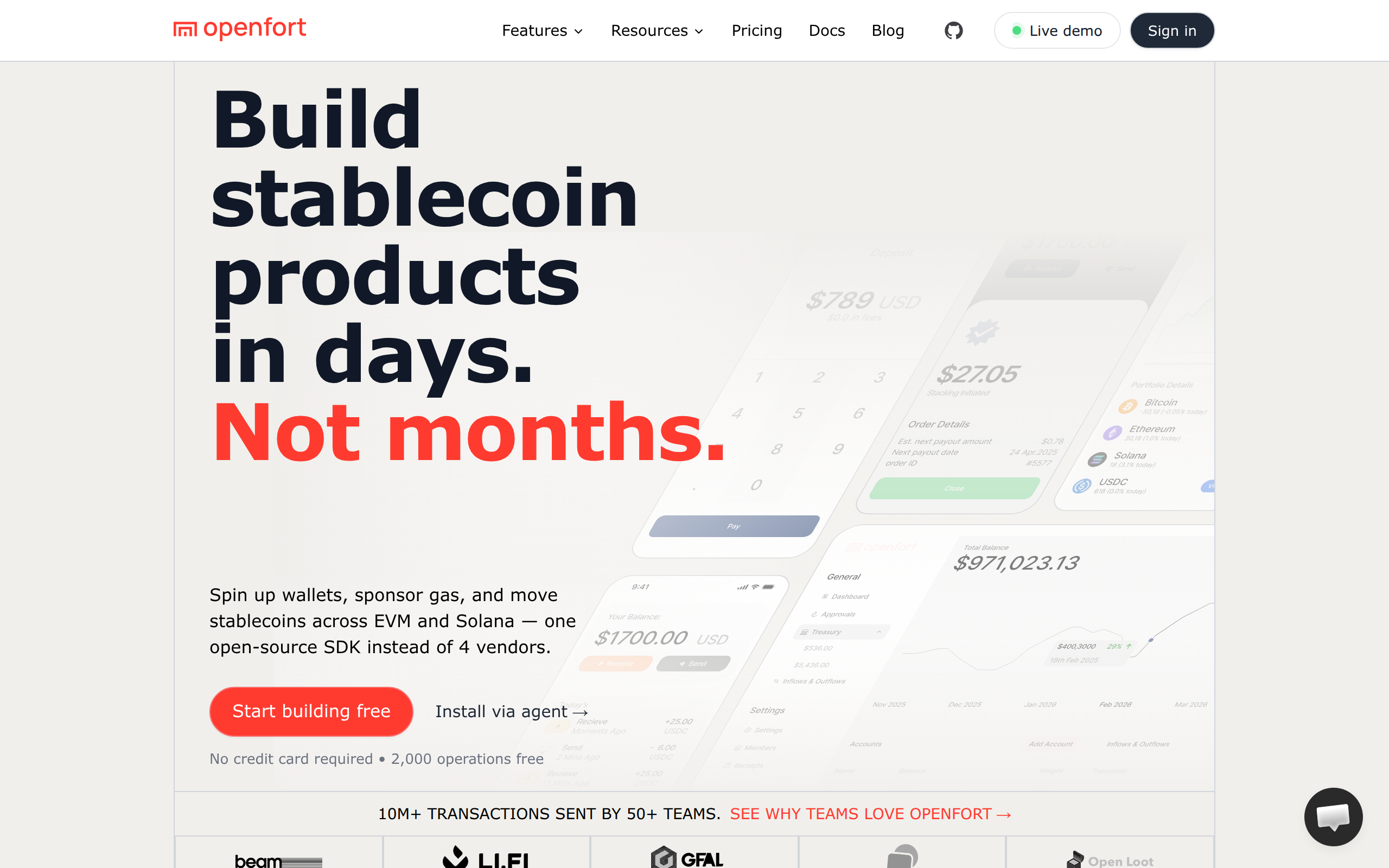
Openfort is an open-source wallet infrastructure platform that replaces the patchwork of multiple vendors with a single SDK for wallets, policies, gas sponsorship, and stablecoin movement.
What It Does
Openfort gives developers everything needed to spin up wallets, sponsor gas, and move stablecoins across EVM and Solana — without stitching together five different providers.
Key Capabilities
-
Embedded & Smart Wallets — Generate user wallets on EVM and SVM chains in under 200ms. ERC-4337 smart accounts with multi-wallet per user, cross-chain ready.
-
Policy-Based Transactions — Set rules for who can sign, how much they can spend, and which contracts they can call — all managed in one place.
-
Agentic Wallets — Purpose-built wallets for AI agents with support for subscriptions, batch operations, and one-click purchases powered by x402 and MPP.
-
Stablecoin Orchestration — Move stablecoins across any routing from any token and any chain with auto-swap and auto-bridging. Gasless transactions across every major EVM chain and Solana.
-
Open-Source Key Management (OpenSigner) — Fully transparent, auditable, and self-hostable key management. No vendor lock-in, no custody of user keys.
Supported Platforms
SDKs available for React, Expo, Unity, Node.js, Swift, and JavaScript — enabling deployment across web, mobile, and game engines.
Use Cases
Remittances, global payouts, payroll, embedded finance, microtransactions, treasury management, AI agent commerce, trading, and recurring on-chain subscriptions.
Pros
- Native ERC-4337/ERC-7702 account abstraction with built-in paymasters, policy engines, session keys, and gas sponsorship for gasless transactions.
- Wallet creation in under 100ms with median signing latency of 125ms, benchmarked faster than competitors (Privy 175ms, Turnkey 350ms, Dynamic 2850ms).
- SDK coverage spans React, Expo, Unity, Node.js, Swift, and JavaScript — enabling wallet integration across web, mobile, and game engine platforms.
- Open-source key management via OpenSigner is fully self-hostable, auditable, and has undergone five independent security audits (CertiK, Omniscia, Cure53, Quantstamp).
- Supports both EVM and SVM (Solana) chains with cross-chain stablecoin routing, auto-swap, and auto-bridging between any token and chain.
- Single SDK replaces 4–5 separate vendors by bundling authentication, embedded wallets, smart accounts, gas sponsorship, and stablecoin orchestration into one integration.
Cons
- Developer infrastructure requiring integration work — teams need technical capability to configure custody models, security policies, and blockchain plumbing.
- All-in-one stack creates platform coupling — if any component (auth, wallets, gas, monitoring) fails or requires customization, the entire integration is affected.
- No self-hosting option for the full platform (only OpenSigner key management can be self-hosted), limiting sovereignty for teams needing complete infrastructure control.
- Small team of 1–10 employees at seed-stage funding raises potential concerns about long-term stability and support responsiveness for production-dependent teams.
- Speed and cost benchmarks (125ms signing, 25% cheaper gas) are self-published by Openfort and not independently verified by third-party testing.
- Operates in a crowded market against well-funded competitors (Turnkey, Privy/Stripe, Thirdweb, Web3Auth/MetaMask, Dynamic/Fireblocks) with larger teams and ecosystems.