

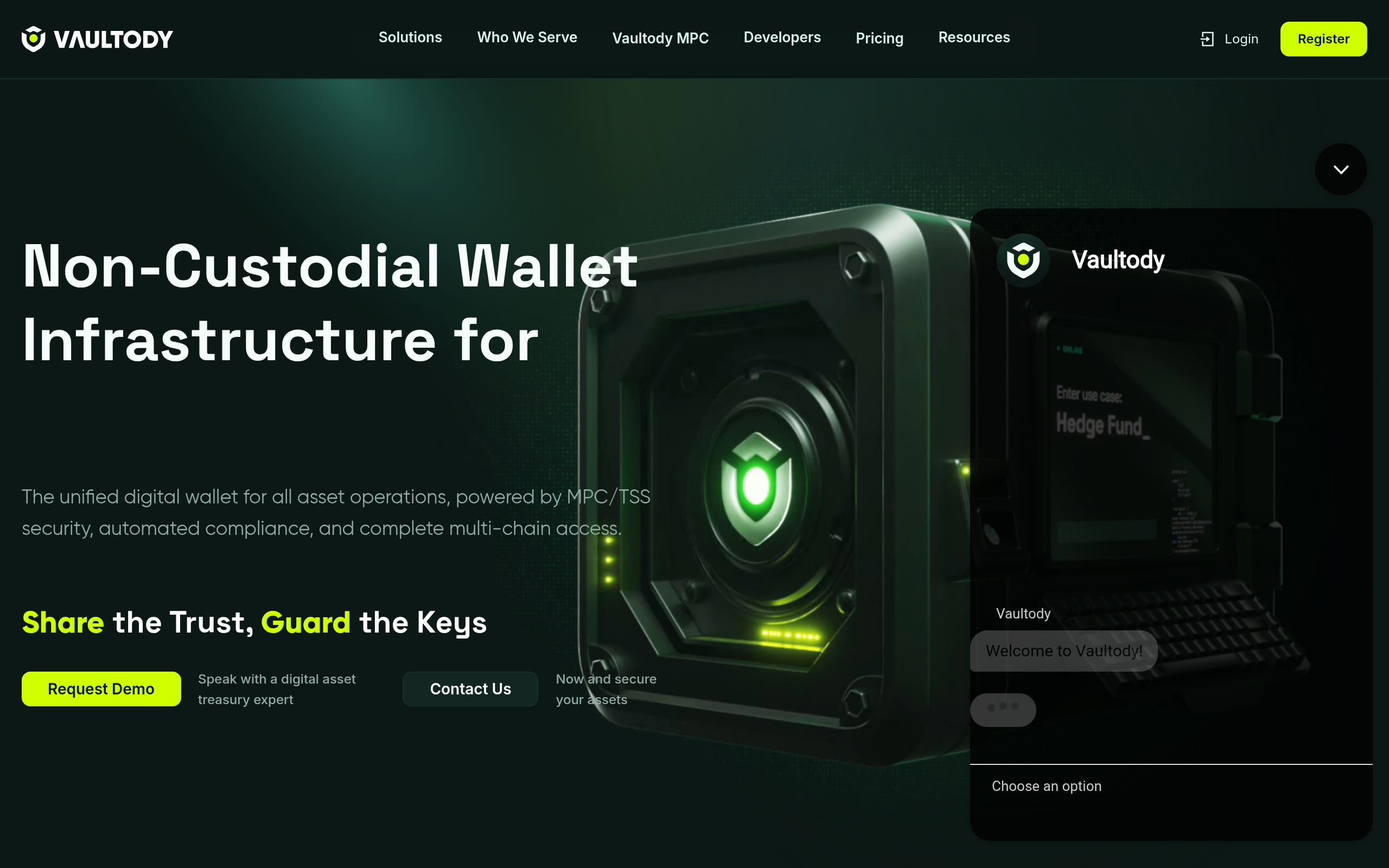
Vaultody delivers enterprise-grade non-custodial wallet infrastructure for financial institutions, fintech platforms, exchanges, and Web3 innovators. Built on a proprietary Multi-Party Computation (MPC) engine, it enables organizations to retain full control of their digital assets while benefiting from institutional security, compliance, and programmability.
Core Solutions
Direct Custody
Infrastructure for institutions managing digital assets on behalf of customers. The organization remains the custodian with configurable approval policies, workflow tiers, and secure MPC key management with API-ready deployment.
Treasury Management
Multi-chain digital asset management with real-time visibility into balances and transactions. Includes automated governance, risk controls, operational reporting, and MPC-enabled signing infrastructure for treasuries, funds, and asset managers.
Wallet as a Service
Enterprise MPC wallet infrastructure for fintechs, exchanges, and Web3 applications. End users retain private key ownership with threshold signing, multi-chain multi-asset support, and full API integration.
Key Features
- Unified Transactions — Seamless operations with unified address creation and fail-safe transactions
- Gas Fee Sponsorship — Fee abstraction allowing any address to sponsor transaction gas costs
- Operational Efficiency — Automated transaction processing, customizable approval policies, and comprehensive API coverage
- Team Roles & Permissions — Enterprise governance with role-based access and approval hierarchies
- Vault Accounts — Hierarchical account structure simplifying transaction management
- Transaction Volume Policy Rules — Intelligent volume limits to safeguard operations and enforce compliance
Security & Compliance
Vaultody is powered by MPC/TSS with Hardware Enclave/TEE security, SecureSign Server, biometric and multi-factor authentication, and vault backup and recovery. The platform is SOC 2 Type 1 certified and pursuing ISO 27001 certification.
Who It Serves
Vaultody serves exchanges, OTC desks, traditional banks, neobanks, gaming and metaverse platforms, AI agent platforms, wallet providers, payment processors, DAOs, DeFi & Web3 projects, hedge funds, and financial institutions.
Pros
- Non-custodial architecture ensures enterprises retain full control of their private keys and assets, with Vaultody acting solely as infrastructure provider and never taking custody.
- SOC 2 Type 1 certified with ongoing ISO 27001 pursuit, providing verifiable institutional compliance credentials for regulated organizations.
- Gas fee sponsorship feature enables any address to sponsor transaction gas costs, removing a common operational friction for enterprise teams managing multiple wallets.
- Proprietary MPC/TSS engine combined with Hardware Enclave/TEE security and SecureSign Server delivers bank-grade cryptographic protection for enterprise digital assets.
- Multi-chain support across 17+ blockchain networks including Bitcoin, Ethereum, Solana, Polygon, Arbitrum, Base, and Avalanche from a single unified platform.
Cons
- Launched in 2024 with Vaultody 2.0 arriving in 2025/2026, the platform is relatively new and less battle-tested compared to incumbent enterprise custody solutions like Cobo and Copper.
- Exchange integrations with Binance, Coinbase, and Kraken are listed as "Coming Soon," limiting immediate connectivity to the three largest trading venues.
- Very limited third-party reviews and independent validation available across major software review platforms, making it harder to verify product quality externally.
- Operates with a small team (10–49 employees), which may raise questions about support responsiveness, SLAs, and long-term scalability for large enterprise clients.
- Tokenization and stablecoin operations solutions are marked as "Coming Soon," reducing the platform's completeness for enterprises needing those capabilities today.