

Description
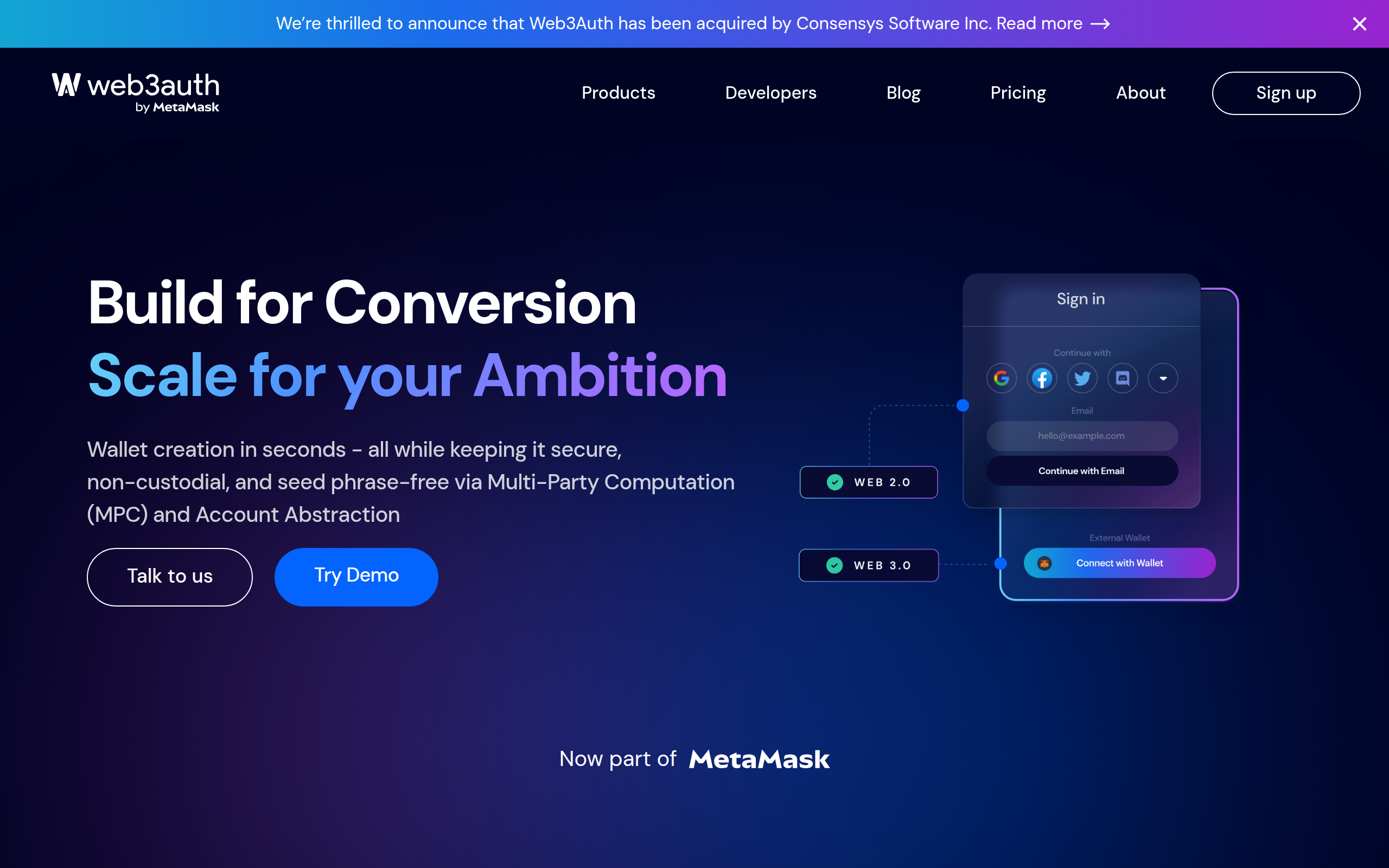
Web3Auth is a pluggable, non-custodial wallet infrastructure that solves the key management problem for Web3 applications. By leveraging Multi-Party Computation (MPC) and Account Abstraction (AA), it enables developers to offer users a seed phrase-free onboarding experience while maintaining full self-custody.
Key Features
- Social & Passwordless Logins — Onboard users with Google, X (Twitter), Email, SMS, Passkeys, and more using familiar Web2 methods
- Multi-Factor Authentication (MFA) — Add extra security layers with customizable MFA options
- Native Account Abstraction — Create smart accounts for users effortlessly
- Custom Authentication — Bring your own auth providers (Firebase, Auth0, JWT) or integrate existing auth systems
- Blockchain Universality — Seamless integration across Solana, Bitcoin, SUI, Aptos, Cardano, EVM-compatible chains, TON, NEAR, Starknet, and more
- Whitelabel UI — Tailor the wallet experience to your branding with ready-to-deploy screens
- Cross-Platform SDKs — Web SDK, Mobile SDKs (Android, iOS, React Native, Flutter), and Gaming SDKs (Unity, Unreal Engine)
- Fiat On-ramp Aggregator — 100+ local payment methods for easy onboarding
Now part of Consensys (the team behind MetaMask), Web3Auth provides SOC2, CCPA, CPRA, and GDPR-compliant infrastructure trusted by DeFi, gaming, loyalty, and social applications worldwide.
Highlights
Pros
- SOC2, CCPA, CPRA, and GDPR compliant with regularly audited codebase, making it suitable for enterprise and regulated environments.
- Social logins (Google, X, email, passkeys) enable users to create wallets in under a minute without any blockchain knowledge — trusted by Fortune 500 brands like NBCUniversal, Fox Media, and McDonald's.
- Now part of Consensys (parent company of MetaMask), providing strong institutional backing and deep integration with MetaMask, Infura, and the broader Ethereum ecosystem.
- Cross-platform SDKs support Web, Android, iOS, React Native, Flutter, Unity, and Unreal Engine, covering virtually every major platform for developers.
- Non-custodial MPC-based key management splits private keys into distributed shares, eliminating single points of failure and the need for users to manage seed phrases.
Cons
- Acquisition by Consensys shifts product roadmap toward MetaMask integration, potentially deprioritizing support for non-MetaMask and non-EVM ecosystems.
- No native support for ERC-4337 smart accounts, gas sponsorship, or session keys — all require third-party integrations such as ZeroDev or Biconomy.
- MPC signing latency of ~500ms+ is slower than TEE-based alternatives (100–200ms), which can impact real-time applications like gaming and trading.
- Auth-only scope — handles key management but not transactions, requiring separate vendors for smart accounts, gas sponsorship, and paymasters to build a complete wallet stack.
- Users experience loading screens during MPC share reconstruction on login, creating friction in the onboarding flow compared to seamless alternatives.